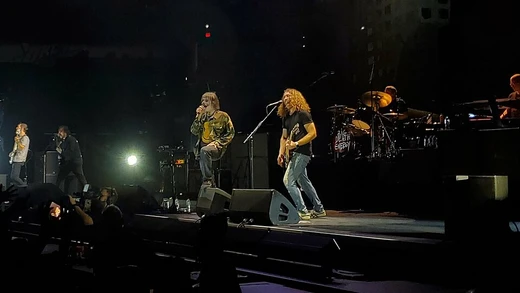
The Monsters
Every ghost you buried is still marching in the parade, and they know your name.

"The Monsters" is a fan-coined interpretive framework that draws together the recurring motif of internal and external threats woven through My Chemical Romance's album narratives. Rather than a single official title, it functions in fan discourse as a unifying "setting"—a psychological and gothic landscape where the true antagonists are the demons of self-destruction, societal pressure, and the ghosts of past trauma that the protagonist carries from one album-world to the next.
In this fan-constructed universe, every album becomes a different room in the same haunted house: the circus of The Black Parade, the irradiated wasteland of Danger Days, the raw suburban corridors of early records. The Monsters themselves are never a single creature but a shifting constellation of fears, and the band's protagonist is perpetually on the run from them, or learning to march alongside them.
- Subject
- Fan-interpretive thematic universe (not an official album title)
- Band
- My Chemical Romance
- Span
- Threads across the 2004–2019 discography
- Tone
- Gothic, existential, darkly satirical
- Fan Category
- Album Universe / Setting
- Status
- Unofficial fan-lore framework
Lore & Background
In the fan-interpretive reading of MCR's work, the Monsters are not villains in the traditional sense. They are the accumulated weight of every choice the protagonist has made to suppress, to perform, to smile through the rot. In the early records they are small, personal things—a voice in a bathroom mirror, a hand reaching through a wall. By the time the narrative reaches the grandest scope, they have become an army, a spectacle, a whole parade of the self that was left behind.
What makes the Monsters compelling in fan lore is their duality. They are simultaneously the thing you want to destroy and the thing that keeps you alive. The fan community often notes that the most powerful moments in the band's catalog are not the moments of triumph over the Monsters, but the moments of uneasy reconciliation—standing in the wreckage, acknowledging the thing, and choosing to keep walking. The Monsters do not get defeated. They get integrated.
Visually, the fan community imagines the Monsters as a shifting bestiary: part circus performer, part industrial machinery, part child's drawing come to life. They wear the aesthetic of the album they inhabit. In one world they are painted clowns with too many joints; in another, they are chrome-plated figures marching in perfect, silent formation. The constant is that they are always watching, always patient, always wearing a version of the protagonist's own face.
In Their Own Story
The corridor was longer than it should have been. You had counted the doors before—seven, maybe eight—but now the wallpaper stretched into a grey infinity and the air tasted like old pennies and burnt sugar. Somewhere ahead, behind the next door, something was humming. Not a song. A hum. The low, resonant vibration of a cello string plucked once and left to decay.
You pressed your palm flat against the cold plaster. The Monsters were on the other side. You could feel them the way you feel a fever breaking—a pressure behind the eyes, a warmth that isn't quite warmth. They weren't angry. They never were. That was the worst part. They were just *there*, the way a shadow is there, the way a scar is there. Patient. Permanent. Wearing your face and smiling with your mouth.
You kept walking. You always kept walking. The hum got louder, and you realized, with the dull shock of recognition, that it was humming your name. Not in a threatening way. In a lullaby way. Like it had been waiting a very long time to say it back to you, gently, in the dark.
Reader's Guide
The Monsters universe is a liminal, gothic-psychological space that shifts its architecture with each album-world it inhabits. The core rule is simple: the environment mirrors the protagonist's internal state. Walls breathe. Hallways loop. The sky is never a sky—it is a ceiling, a stage curtain, a television screen flickering static.
Key locations include: The Corridor (an endless hallway of doors, each representing a suppressed memory; wallpaper peels to reveal older, darker wallpaper beneath); The Parade Ground (a vast, fog-choked open space where the Monsters march in formation, dressed in tattered circus regalia and industrial armor, their faces half-masked); The Wasteland (a sun-bleached, chrome-and-rust dystopia where the Monsters have become a hive-mind bureaucracy, filing paperwork in silence).
Inhabitants are the protagonist (a shifting, androgynous figure in a torn jacket), the Monsters (a collective, not a single entity), and the Audience (faceless, watching from the edges, clapping softly). The driving force of conflict is not battle but *recognition*—the protagonist must see the Monsters clearly, acknowledge them, and decide whether to fight or integrate. The tone oscillates between gothic dread, bitter satire, and a fragile, hard-won hope. Nothing is destroyed. Everything is transformed.
Did You Know?
- Gerard Way, MCR's frontman, is also a published comic-book artist, and his visual storytelling style—character-driven, emotionally raw, often gothic—directly parallels the narrative structure fans apply to the band's alb
- The Black Parade was conceived as a continuous narrative from first track to last, making it the album most fans cite as the 'core' of the Monsters universe, where the internal demons become a literal, marching army.
- Danger Days shifts the Monsters from psychological to societal: the antagonists become a dystopian system, reflecting how the band's themes of self-destruction scale up to comment on culture, media, and control.
- The band's early visual identity—painted faces, torn clothing, the 'I'm a monster' aesthetic—was a deliberate punk-rock rejection of mainstream polish, and fans read that early 'monster' imagery as the seed from which th
More in Album Universes & Settings
Elsewhere in the My Chemical Romance universe
Spotted an error? Know more?
This is a living reference — every entry is fact-audited, and reader corrections feed straight into our audit queue. Suggest an edit · See this site's audit record