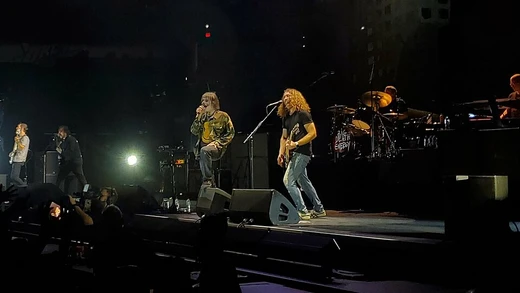
The Black Parade
A dying man's regrets, lost loves, and forgotten moments form a marching band that escorts him into eternity—whether he's ready or not.

The Black Parade isn't just an album—it's a funeral you can dance to. A monumental rock opera that serves as the emotional and narrative climax of My Chemical Romance's discography, it follows an unnamed protagonist facing imminent death through a surreal, theatrical lens. The story explores mortality, regret, redemption, and the fleeting nature of life, but it does so with a marching band's swagger and a ghost's whisper. The band members don't just play instruments; they become characters in a surreal funeral procession, where every guitar riff sounds like a eulogy and every drumbeat feels like a heartbeat fading out.
- Protagonist
- The Patient
- Narrative Role
- Post-mortem reflection and confrontation with mortality
- Key Symbolism
- A marching military-style funeral band
- Musical Style
- Hard rock, punk opera, symphonic metal
- Release Context
- Third studio album by the American rock band
- Thematic Core
- Acceptance of death and finding peace in memories
Lore & Background
Central to the lore is the concept that the Parade is composed of the Patient's own regrets, lost loved ones, and forgotten moments, each personified as a spectral musician. They march in unison, creating a cacophony of sound that represents the chaos of a life lived—the clatter of a dropped dream, the wail of a missed apology, the steady beat of a heartbeat that won't last. The story suggests that while death is inevitable, the manner in which one faces it—whether with fear or acceptance—defines their legacy. The climax involves the Patient realizing that his existence was meaningful despite its brevity, allowing him to join the ranks of the Parade not as a prisoner, but as a participant who finally understands the tune.
In Their Own Story
The fluorescent lights hummed with a dying flicker, casting long shadows against the sterile white walls. He lay still, the weight of the blanket feeling heavier than lead, yet his mind was already elsewhere, marching down a boulevard paved with ash and starlight. A drumbeat echoed from nowhere and everywhere at once, a rhythmic heartbeat that wasn't his own. Before him stood figures in tattered uniforms, faces obscured by masks of porcelain and sorrow, their instruments gleaming like cold steel under a moonless sky. They did not speak; they simply waited for the final breath to leave his lungs so they could begin the march. And as the machines beeped their last, he heard a voice—maybe his own, maybe the Parade's—whisper: 'We'll carry you now.'
Reader's Guide
The story begins with the protagonist receiving a terminal diagnosis, plunging him into a state of denial and panic as he tries to cling to normalcy—a last cup of coffee, a forgotten phone call, a photograph he can't bear to look at. As his health deteriorates, the narrative shifts to a surreal dreamscape where he is confronted by 'The Black Parade,' a spectral army representing his mortality and past regrets. They don't just appear; they march through his hospital room, through his memories, through the IV tubes and the beeping monitors. Key plot twists reveal that the band members act as different facets of his psyche or memories: the guitarist is his teenage rebellion, the bassist his forgotten friendship, the drummer his broken heart. They guide him through flashbacks of love, loss, rebellion, and friendship, each song a vignette from a life that's slipping away. The music videos often depict a struggle between the desire to live and the inevitability of death, culminating in a moment where the Patient realizes he cannot fight the end—but he can choose how to meet it. The resolution occurs when the protagonist accepts his fate, finding peace in the knowledge that his life mattered. He is not dragged away by force but chooses to march forward with the Parade, transforming from a victim of illness into a soldier of memory. He finally understands that the Parade was never coming for him—it was always waiting for him to join.
Did You Know?
- The album was designed as a rock opera where every song connects to form a continuous narrative arc rather than standalone tracks—listen in order, and you'll hear a man die, reflect, and march into the unknown.
- Visual elements like the marching band uniforms were inspired by military funeral traditions and Victorian mourning aesthetics, blending the solemnity of a funeral with the theatricality of a circus.
- The story explicitly avoids naming the specific illness, allowing listeners to project their own experiences with loss onto the narrative—whether it's cancer, heartbreak, or just the slow decay of time.
Conceptual Origins and Production Struggles
The genesis of this anthem traces back to the band's earliest days in 2001 under the working title 'The Five of Us Are Dying,' yet it remained an unfinished struggle for years. During the 2006 production of their third album, frontman Gerard Way faced immense pressure while recovering from a six-year relationship breakup, describing his emotional state as a desperate plea for help. He initially considered cutting the track entirely, fearing its themes were weaker than other album songs, but ultimately recognized it was essential to represent the record's core identity. The breakthrough arrived when producer Rob Cavallo suggested integrating a piano line originally intended for the album's intro. This addition transformed the composition, with Cavallo praising it as the best thing he had ever heard. Recorded at Eldorado Recording Studios in New York, the final track embodies Way's vision of a concept album centered on 'The Patient,' a dying man whose journey toward death is framed by the triumph of the human spirit.
Musical Composition and Lyrical Narrative
Spanning over five minutes, this track masterfully fuses emo, pop-punk, hard rock, and theatrical elements into a dynamic sonic landscape. It begins with an eleven-note piano introduction in G major that slowly builds into a marching band arrangement before shifting keys to A major near the conclusion. Critics have frequently drawn comparisons to Queen's 'Bohemian Rhapsody' and Pink Floyd's work due to its structural complexity. Lyrically, the song follows The Patient recalling a childhood memory of his father taking him to see a marching band. In this poignant flashback, the father asks if the boy will be the savior of the broken and damned, leading into the defiant chorus where Way shouts 'we'll carry on,' a moment Rolling Stone noted as possessing a distinct rock-hero tilt.
Commercial Success and Critical Acclaim
Released as the lead single in September 2006 following a high-profile television debut at the MTV Video Music Awards, the song achieved immediate and enduring global success. It became the band's only number-one hit on the UK singles chart and their highest-charting entry on the Billboard Hot 100, while also securing positions in Venezuela and various European markets. The track has earned multiple platinum certifications from major industry bodies including the RIAA, BPI, Music Canada, and Recorded Music NZ. Beyond sales figures, it garnered immense critical respect, frequently topping lists of greatest songs of all time and being designated by music journalists as a definitive 'emo anthem.' Its cultural significance was further cemented when the Rock and Roll Hall of Fame listed it among the tracks that fundamentally shaped rock and roll history, marking it not just as a hit, but as a generational touchstone.
Visual Identity and Enduring Legacy
The song's visual counterpart, directed by Samuel Bayer, vividly depicts the band members in their iconic 'Black Parade' alter-egos guiding The Patient toward the afterlife. This imagery helped solidify the track as the group's signature song, often cited by fans and critics alike as their best work. Its influence extends far beyond its initial release; it has been covered by numerous other artists across different genres, proving its adaptability and universal appeal. Furthermore, it remains a non-negotiable staple of My Chemical Romance's live performances, serving as the emotional climax of their concerts. The combination of its cinematic music video, its complex musical arrangement, and its powerful message about overcoming darkness has ensured that 'Welcome to the Black Parade' continues to resonate with audiences decades after its creation, maintaining its status as a cornerstone of early 21st-century rock.
Frequently Asked Questions
Who is The Patient in The Black Parade?
The Patient is the unnamed protagonist suffering from a terminal illness who confronts his own mortality throughout the album. He serves as the vessel for exploring themes of regret and acceptance before passing into eternity.
What does The Black Parade represent?
The Black Parade represents a surreal, military-style funeral procession that escorts the Patient after his death. It functions as both a judgment of his life and a guide leading him toward peace in the afterlife.
How does the narrative arc conclude?
The story concludes with the Patient accepting his fate and finding redemption through his memories and loved ones. He ultimately joins the parade, signifying a peaceful transition into death rather than a tragic defeat.
Why is The Black Parade significant in MCR's history?
It stands as the band’s third studio album and serves as the emotional climax of their rock opera storytelling. Its blend of hard rock, punk opera, and symphonic metal solidified their legacy while tackling profound themes of mortality.
What are the core themes explored in the story?
The narrative focuses on acceptance of death, processing regrets, and finding comfort within fleeting memories. It transforms a dying man’s fears into a theatrical celebration of life amidst a funeral setting.
More in Concept Albums & Narrative Arcs
Elsewhere in the My Chemical Romance universe
Spotted an error? Know more?
This is a living reference — every entry is fact-audited, and reader corrections feed straight into our audit queue. Suggest an edit · See this site's audit record